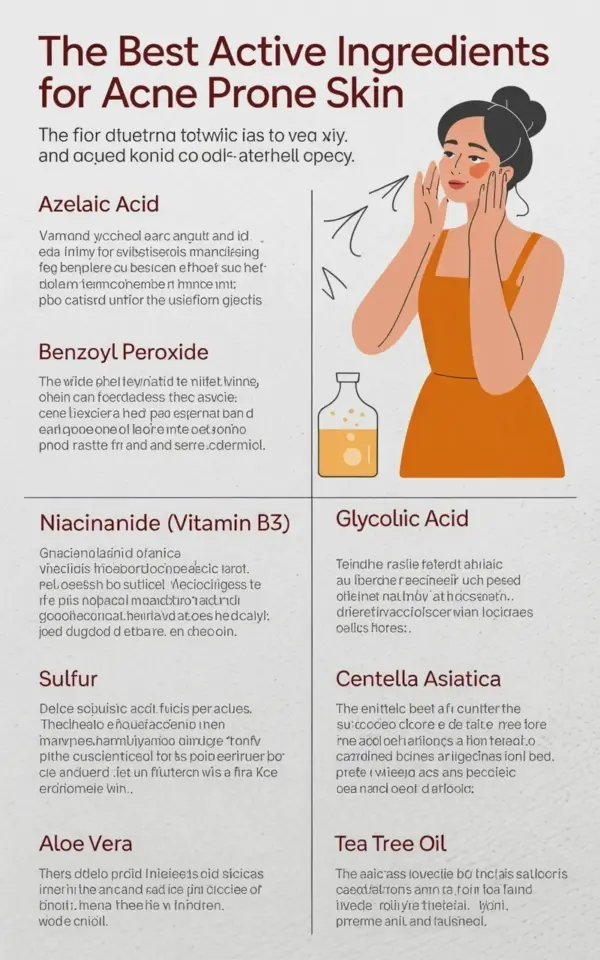
Do you see that infographic up there, the one with the red title and the woman in the orange dress touching her face? I basically have it memorized. I’ve spent the better part of a decade trying to hack my own skin, and honestly, that little chart is the cheat sheet I wish I had back when I was buying every random cleanser with a “charcoal” label on it. We’re talking about acneproneskin, which is a beast of a different color than the occasional stress pimple. It’s the persistent, annoying, why-won’t-you-leave kind of acne that requires you to understand the chemistry of your own face. It took me years to realize that the real solution wasn’t about scrubbing harder, but about picking the right weapons.
So, let’s talk actives. These are the ingredients that actually change the behavior of your skin, not just the fragrance in your cleanser. I want to break down the stars of that infographic, the ones I have personally tested on my own stubborn chin and jawline. I’ll tell you what works, what burned me (literally), and how to decode your own product labels. Grab your nightstand moisturizer, and let’s see if your stash is actually pulling its weight.
Why Azelaic Acid is the Underrated Multi-Tasker
The infographic puts azelaic acid right up there at the top, and for good reason. This is the ingredient that finally calmed down the angry red marks, called post-inflammatory hyperpigmentation, that my old breakouts left behind. It’s not a harsh peel; it’s more of a gentle swoop-in-and-quiet-things-down kind of active.
I have tried a 10% gel and a 15% cream, and honestly, the higher strength isn’t necessarily better if it makes your skin itchy for a week. And it did make me itchy, but I stuck with it. The benefit is that it hits multiple pathways at once. It unclogs pores, it calms redness, and it evens out skin tone. It’s actually a great option if you have acne and rosacea, something a simple salicylic acid serum never addressed for me. Plus, it’s generally considered safe for darker skin tones, so there’s no risk of the hypopigmentation that sometimes comes with more aggressive acids.
Benzoyl Peroxide: The Heat Ray Approach
Benzoyl peroxide (BPO) is the old reliable, but oh boy, it is not subtle. It works by introducing oxygen into the pore, which kills the anaerobic bacteria that cause inflammatory acne. That bacteria doesn’t stand a chance, but neither does your favorite pillowcase.
Here’s the thing, BPO bleaches fabric. I learned this the hard way with a brand new navy blue towel, which is now a tie-dye masterpiece of white splotches. If you use this, keep your white towels sacred.
– It’s best used as a *spot treatment* rather than an all-over daily lotion; your skin barrier will hate you otherwise.
– You usually find it in strengths from 2.5% to 10%. The 10% doesn’t mean it works faster, it just means it peels your skin faster.
– Use only once a day, at night, and *always* moisturize over it. Seriously, don’t skip the moisturizer.
I’ve found that the 2.5% prescription-strength stuff (which you can also grab on a site like Apostrophe) is far superior to the gritty 10% Old Spice-esque formulations of my teenage years. It is a drying demon, but if you have a huge cystic zit that needs nuking, BPO will flatten it.
Salicylic Acid: Your Pore Unclogger, But Be Careful
Salicylic acid is a beta hydroxy acid (BHA). This is the ingredient for blackheads and the general “dirty” feeling of congested skin. Unlike BPO, it’s oil-soluble, meaning it can dive deep into the lipid layers of your skin to dissolve the dead skin cells and sebum trapped inside the follicle. It doesn’t kill bacteria, but it removes the buffet table they feed on.
My personal issue with salicylic acid is the overuse. When I first started, I used a 2% liquid exfoliant every morning and night. My skin became squeaky clean, which I thought was great, until I realized that “squeaky” was just my stratum corneum begging for mercy. I peeled like a snake for two weeks. With oilier skin types you might be okay with daily use, but for me, using it every other day was the sweet spot.
Adapalene: The Next Generation Retinoid
The infographic mentions this one, and I am so glad it’s available over the counter now. Adapalene (often known by the brand name Differin) is a third-generation retinoid. Retinoids are vitamin A derivatives that speed up cell turnover. What does that mean for you? Your cells turn over faster, so the pores don’t get clogged with old, sticky skin cells that trap oil.
Ok so, here is the warning they put on the box, but let me say it earnestly: you will purge. When I started adapalene, for about three weeks, my face got worse before it got better. Every little clogged pore that was sitting underneath the surface suddenly rose to the top. It looked awful, but this is kind of like a Spring cleaning for your face. It forces the gunk out. You have to trust the process. Start off using it twice a week, then three times, and eventually you might hit nightly use without your face flaking off. Patience is not a virtue here, it is a requirement.
Niacinamide: The Best Friend Your Skin Barrier Needs
Here’s the plot twist in the story of acneproneskin. You can’t just attack bacteria and shed skin cells all day long; you need to repair the fortress at the same time. Enter niacinamide, which is a form of vitamin B3. This isn’t an acne killer in the way BPO is, but it is a critical sidekick because it repairs your skin barrier and regulates oil production.
This is the ingredient that helped me go from “red and angry” to “calm and controlled.” It reduces inflammation (so your pimples look less scary) and it prevents water loss. You know how a pimple looks so much worse when the skin around it is dry and flaky? That’s barrier damage. I prefer a formulation with about 4% to 5% niacinamide, and yes, I can tell the difference when I stop using it. It’s the supportive friend in the group chat that keeps everyone from fighting.
How to Build a Routine With These Active Ingredients
Okay, so now that you have a list as long as your arm, here is the actual puzzle. Do not use all of these at once. That is a one-way ticket to chemical burns and a destroyed moisture barrier. You have to pair them with discipline.
– **In the morning:** A gentle cleanser, a niacinamide serum, and a heavy moisturizer. Sunscreen, lots of it, since these actives make your skin photosensitive.
– **In the evening:** Pick either a BPO spot treatment *or* an adapalene treatment. Don’t stack them. Wait for the adapalene to dry, then apply a layer of azelaic acid if you want the brightening effects, but that might be too much for sensitive folks.
– **Listen to your skin.** If it stings to put on moisturizer, you have stripped your barrier. Back off on the acids for two days and just cleanse, moisturize, and use SPF.
I know it is tempting to buy every serum on the shelf. I spent a fortune on a collection of things that turned my bathroom into a glittering apothecary. But the real victory for me was simplifying. Once I isolated the acneproneskin culprits from the infographic, I put the rest in a drawer and let them work.
There isn’t one magic bullet, no matter how much the ads promise “overnight success.” It’s a combination of the right actives, the right patience, and maybe a good appreciation for the chaos of a zit that shows up right before a big event. The process is tedious, but eventually, you learn what your skin likes. You start to actually read the ingredient list like a recipe for dinner rather than a foreign language.
Take a screenshot of that pretty chart with the orange dress and keep it on your phone. The next time you’re staring at the back of a bottle in the drugstore, wondering if it’s worth the hype, pull it up. Your skin will thank you, and so will your wallet. What ingredient have you found your skin actually hates? Let me know in the comments, I’m curious to see if I’m the only one who burned their face with a certain acid.
Leave a Comment