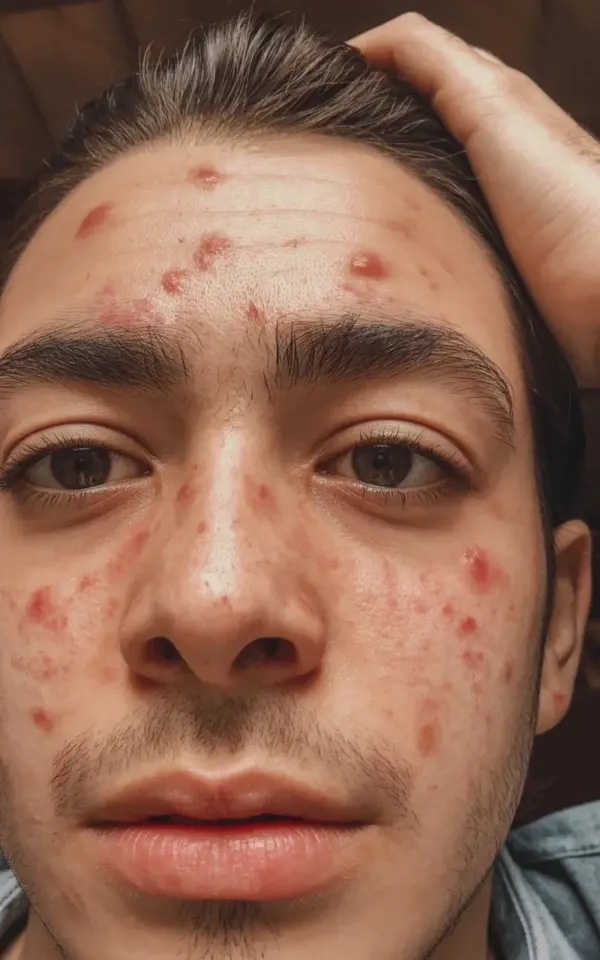
That face I made when my forehead decided to redecorate itself with three angry red bumps right before a friend’s birthday dinner? Yeah, that was the moment I realized my usual “hide it with concealer” plan wasn’t cutting it anymore. This close-up selfie, with my hand pressed against my head like I’m solving a math problem, pretty much sums up the last few months of my ongoing acne routine. The redness across my nose and cheeks, the blemishes that seemed to multiply overnight, the warm lighting that made every single spot look deeper than it actually was. I look tired of my own skin, honestly.
I didn’t have a breakthrough moment or a skincare epiphany. I just got sick of the coverage game. So I swapped my heavy creams for a lightweight spot treatment with salicylic acid, and it turned out to be the push my skin needed. It’s not a magic eraser, but it’s the closest thing I’ve found to a breakthrough fix for my specific kind of angry, red acne. If you’re reading this while frantically googling with a towel on your head, this one’s for you.
Why Salicylic Acid Became My Go-To Breakout Fix
Look, I’m not a dermatologist, and I definitely don’t play one on the internet. But after years of trying every clay mask and charcoal scrub that promised the moon, I learned one basic thing about my own face. Salicylic acid works differently than the stuff I was using before. It actually gets inside the pore and clears out the gunk that causes the swelling, rather than just sitting on top of the skin like a drying mask.
My skin is the sensitive kind that turns beet red if you look at it wrong. Most acne treatments, especially those gritty scrubs, just made the redness worse. So my acneroutine shifted. I wanted something targeted that wouldn’t nuke my entire face. This lightweight spot treatment lets me draw a little white circle around the specific blemish on my nose or cheek and leave the rest of my face alone.
Here’s what I noticed within about a week of consistent use:
- The deep, painful bumps on my forehead started to flatten out instead of coming to a head.
- The redness around my nose and cheeks calmed down enough that I could skip the color-correcting primer for the first time in months.
- My skin stopped peeling like a snake, which was a huge win since my old treatments were basically chemical burns.
- I stopped picking. Because the bumps went away faster, there was less temptation to attack them with my fingers. (That’s a big one, nobody talks about that.)
Layering Spot Treatments Into an Existing Acne Routine
Ok so, here’s the thing that took me way too long to figure out. You can’t just slap a spot treatment on top of a heavy moisturizer and expect it to do anything. The product needs to actually reach the skin. I learned this the hard way when I spent two weeks applying my new gel over my thick night cream, wondering why nothing was changing.
Now, my order of operations looks like this. Cleanser first, then a toner, then the spot treatment dabbed directly onto the blemish. I wait a minute, just enough to let it sink in, and then I go in with a very light, oil-free moisturizer only on the edges of my face where I didn’t apply treatment.
It sounds annoyingly precise, but the payoff is real. The treatment actually works because it’s not being blocked by a thick barrier. My skin health improved because I wasn’t suffocating my breakouts under multiple layers of goop. Keep it simple, that’s the whole secret. Apply, wait, moisturize around, sleep.
How I Calm the Redness That Sticks Around
The breakout itself is one problem. The bright red mark it leaves behind for weeks is a whole other beast. My forehead was a minefield of these reddish-brown spots long after the actual pimple had gone. That’s what made my skin look so unhealthy in that photo, it wasn’t just active acne, it was the aftermath.
I started being savage about not picking at my skin. Picking makes the redness last twice as long, and honestly, I was my own worst enemy. I also introduced a simple, fragrance-free centella toner into my routine. It’s not a fancy ingredient, but it works to calm that flushed feeling after I apply the acid.
Another weird but practical tip? I switched my pillowcase every two days. Not weekly, every two days. I bought a four-pack of cheap cotton ones just for this purpose. It sounds silly, but it reduces the bacteria that hangs around my nose and cheeks while I sleep. My skin health isn’t a mystery, sometimes it’s just about not sleeping in your own grime.
The Two Mistakes That Kept My Skin Red and Angry
I’m a slow learner, so I made both of these mistakes before I found a rhythm. The first one was overdoing the acid. I thought if one application was good, four was better. Bad move. I ended up with a damaged moisture barrier that made my entire face feel tight and look even redder than the acne itself.
The second mistake was mixing the wrong ingredients. I was using benzoyl peroxide in the morning and salicylic acid at night, thinking I was nuking the problem from both sides. All I did was irritate my skin to the point where it was producing more oil to compensate. I stopped the benzoyl peroxide completely. Now, the salicylic acid is the star, and I use it only once a day. Less actually is more, especially when your skin is already stressed out.
If you’re going to try this breakout fix, just pick one active ingredient and stick with it for a few weeks. Your skin needs time to adjust. Don’t be like me and assault it with a cocktail of harsh chemicals while your nose is literally peeling off. I put my hand on my head in frustration more times than I care to admit during that peeling phase.
Why I Stopped Chasing the “Perfect” Screenshot Skin
You see those influencers with flawless skin, posting their 12-step routines, and you think you need all of that. I fell for it hard. I had a shelf full of serums, essences, and ampoules that cost me a fortune and did absolutely nothing. My skin was still throwing a tantrum across my forehead and nose.
Going back to basics with just a spot treatment taught me that my skin doesn’t need a lot of products. It needs consistency and a targeted approach. My acne-prone skin selfie is not pretty, but it’s real. It shows what happens when you stop hiding and start treating the actual issue instead of trying to paint over it with the perfect lighting and a filter.
I still use makeup, don’t get me wrong. But now a full coverage foundation is a choice, not a necessity. I feel a lot less stressed about my skin when I know I have a reliable way to fight a flare-up as soon as it pops up. The mental shift honestly did more for my skin health than the acid did, because stress is a huge trigger for me.
One Small Tweak If You Want to Try This Breakout Fix
If you’ve read this far and you’re ready to ditch the heavy concealer, here’s my advice. Don’t go out and buy the entire line of products. Just get one lightweight spot treatment with salicylic acid, and maybe a basic cleanser and moisturizer. The treatment is the workhorse, the other stuff is just there to support it.
My “curated” roundup of ideas basically boils down to this pinpoint strategy. Apply the acid to the blemish, not the whole face. Let it sit. Keep your hands off your face. Change your pillowcase. Drink your water. That’s it. It’s not an exciting or Instagram-worthy routine, but it works for the angry red spots that were dominating my forehead and nose in that photo.
You don’t have to live in a state of constant stress about the next breakout. You also don’t have to cake your face in makeup to leave the house. A simple routine, done consistently, can take the edge off. My skin isn’t perfect, and it probably never will be, but it’s calmer, and that’s a win I’ll happily take.
Give your skin a few weeks to figure itself out. If you have a spot treatment sitting in your drawer that you gave up on, try it again with this simpler approach. And if you have your own way of dealing with stubborn redness, I’m honestly all ears. Share your own acneroutine below, it helps to know we’re all in this together.
Leave a Comment